Last time, I waxed un-lyrical about composing my industry keynote at the AIDB Workshop @ VLDB (still haven't been ejected for being sus). Onwards!
We've entered the age of AI and agents. Frontier models can plan, use tools, write code, summarize documents, compose poetry in iambic pentameter or haiku. Every day we see new articles about the latest solved Erdős problem and posts about increasingly capable agents. Anyone who has used these agents can vouch for how amazing they sometimes are.
At the same time, it's clear to even the most AI-pilled among us that we aren't there yet. Some of us, to paraphrase Terry Pratchett, are being dragged kicking and screaming into the century of the agent. No one ever seems to want to, for example, lead us gently by the hand.
We aren't there not because the agents aren't good. They are often existential-crisis-inducingly good. But there is a chasm - or at least a gap - between a model that sometimes-but-not-always has a capability and a product. A gap stuffed with edge cases, product constraints, user expectations that shifted since I started writing this sentence, and more.
As models get better, the goalposts shift and sometimes even change shape. Users see that a model got better, or solved an Erdős problem, and expect the product to do something harder that 'obviously' should work now.
Why aren't we there yet? The world (including the models) moved faster than the system. The capabilities are there, but reliable outcomes in products need a higher '9' of reliability. As a result, we have two stories - a capabilities story of better models, which use better tools, better, and an outcomes story where products have ragged edges where models don't do what products make users think they should.
| ‘Capability’ story says | ‘Outcomes’ story says |
|---|---|
| AI can plan and use tools | Context is incomplete and changing |
| AI can generalize | Conventions are product specific and evolving |
| Actions can be automated | Authority and effects are bounded and varying |
| AI trajectories produce experience | Useful feedback is noisy, sparse and delayed |
| Stronger AI needs smaller harnesses | Products have stable contracts |
| AI follows instructions | User expectations are ill-defined and contextual |
Look at all the dynamics: incomplete, changing, evolving, varying, noisy, sparse and delayed. The outcomes story is about things that need to stay the same while the things they are built on move - not just in different directions, but at different timescales.
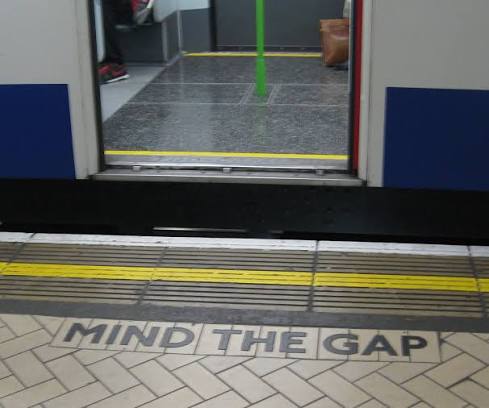
So, what do we need? Not just models, not just prompts - but systems. We need systems that can keep doing what they were designed to do even as the things around them - users, models, expectations - change. I think that this systems gap is deeply interesting, hard to concretize, and also selfishly the thing that keeps me employed. If you are a systems researcher looking for hard problems that really matter - problems where the solution isn't just 'use a better model' - it may be fun to not just mind the gap, but embrace it! I'd warn you, though: the view down here is terrible, the problems are messy, the benchmarks don't exist, you'll spend half your time arguing about what correct even means and the company - the company is people like me. I'll bring snacks. Maybe.
(H/t Vyas Sekar for the title. As always, but particularly today, opinions expressed are solely my own and do not indicate the views or opinions of my employer, or likely anyone at all.)